| I will start by trying to
outline where middle C is on each
instrument, so that they are tuned in the correct octave. If unsure, tune
an octave lower, then no strings will be broken. It will be obvious
if it is an octave too low, because the strings , especially the lower
ones, will seem much too slack, and will rattle. If you have no piano
for middle C, the chart should allow you to tune from other strung
instruments, (provided they are roughly in tune!)
On the mandolin, as with the violin, many musicians recommend tuning the A string first, and then tuning the others to that, then the instrument will be in tune with itself. With the vagaries of different string thickness, varying string height and scale length, it is not always wise to rely on electronic tuners that cannot address these variables. |
|||
|
|
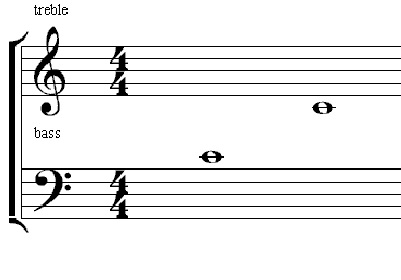
The original 'Grand Stave' of 11
ledger lines was divided into 2, treble and bass, for ease of use.
Middle C is on the on the line above the bass clef, and on the line
below the treble.
(Warning for guitarists: guitar music is often written in 'Transposed Pitch', an octave higher than it actually is!!) The modern system is based on the note A above middle C being 440Hz, but this has not always been the case. Many older instrument are tuned to an A at 435 (which is why many old melodeons sound flat!) or even as low as 415Hz. |
||
|
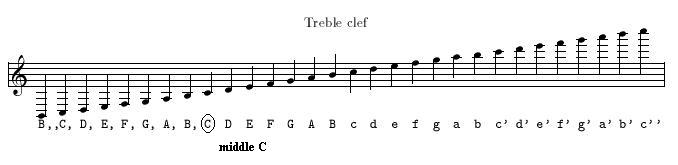
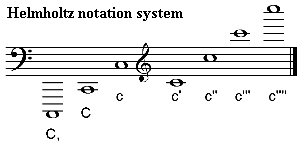
Care should be taken when using these charts..... I have set up the tunings below to match the English chart, but Helmholtz system is often seen as well. Middle C is still the same note. |
|||
|
Middle 'C' |
|||
| Instrument (click for instrument page) | Scale Length | Where is middle C? | Traditional Tuning: bottom up |
| Guitar | around 65cms | 1st fret on 2nd string. | E,,A,,D,G,B,E |
| Mandolin/mandriola | 30-36cms | 5th fret on 4th string. | G,DAe |
| Mandola | 42-50cms | 5th fret on 3rd string. | C,G,DA |
| Irish Bouzouki | 53-58cms | 3rd fret on 2nd string. | G,,D,A,E |
| Waldzither (D) | 39-45cms | 3rd fret on 4th string | D, A,A, DD F#F# AA |
| Waldzither (C) | 46-50cms | Open 3rd string | C, G,G, CC EE GG |
| Greek Bouzouki (C tuning) | 64-69cms | 3rd fret on 2nd string. | C,C F,F A,A, DD |
| Greek Bouzouki (D tuning) | 64-69cms | 1st fret on 2nd string. | D,,D, G,,G, B,B, EE |
| Lombardy Mandolin | 30-31cms | 1st fret on 5th string. | G, B, E A d g |
| Bandurria | 27cms | 4th fret on 6th string. | G,# C# F# B e a |
| Laud | 1st fret on 3rd string. | G,,# C,# F,# B, E A octave below bandurria | |
| Cittern: (great variety possible)
see alternative waldzither tunings. |
54-66cms | 3rd fret on 2nd string.
3rd fret on 3rd string. |
DGDAD zook with extra bass
GDADA zook with extra top |
| Mandolin Banjo | 30-36cms
55-58cms |
5th fret on 4th string.
3rd fret on 2nd string. |
G,DAe
Tenor banjo an octave lower than mandolin |
| Fado Guitar, Lisbon | 44-46cms
47cms |
1st fret on 4th string.
3rd fret on the 4th string. |
bb, aa, ee, Bb, Aa, Dd
aa, gg, dd, Aa, Gg, Cc |