Home Mandolin Fretting Hospital


Re-levelling the frets

Often necessary to remove small dips, the odd high fret, after a re-fret, or to level after fingerboards have been set on a shim.

In this example, it is obvious that the high frets are not only at either end.

It will often be the case, that you find a mandolin with only a slight bow in the neck. In this case it is sometimes possible to relevel the frets and thereby erase the dip. It is essential that you start with sufficient depth to the frets to work with.


First I remove the nut. Afterwards, I use sandpaper stuck to a block of wood with a FLAT bottom surface, as a sanding block. The block is about as long as the fingerboard. When you begin, you will only touch the highest frets, here typically at either end of the fretboard.

I have found used 80 grade sandpaper works quite well and quite quickly, without ripping the frets to pieces. If the top end of the fretboard is very thin, I would normally tape up the top either side of the board to protect it.

Gradually, as the frets are levelled, the brass dust will spread to more of the frets.

Once the dust has spread to all the frets, I stop and change briefly to a finer grade paper (120) to finish off. The tops of the frets will now be flat. The must be dressed without lowering the height. The tops of the frets must be rounded, so the the strings are stopped at one point only. This can be done with needle files, but is very difficult and time consuming. The best tool is a fret file, available from StewMac.

The ends must be dressed. A dressing block saves endless time, and gives you a good standard finish. Even with the block, it is necessary to round off edges with a needle file to finish.

I usually finish by laying a steel rule along the fret tops, and trying to slide a piece of paper under it at any fret. You will often find the odd low fret like that, hidden by the spread of the dust from those around it. If it is just an isolated fret, I push a small wedge of something rigid under one end to lift it. A piece of very fine, old saw blade works well.
Here are the tools I use:

80 grade paper on a flat wooden sanding block and 120 paper on an alumimiun sanding block.

An angled end file available again from StewMac for preliminary end-dressing.

Fret file (with interchangeable files) with wooden handle, and a flat needle file.

Fret levelling is easy to do badly. To do a good job, the right tools help enormously, and a good deal of time and patience.


Re-fretting
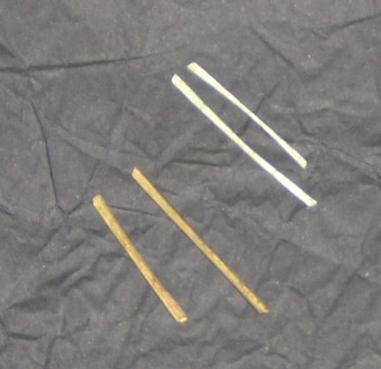
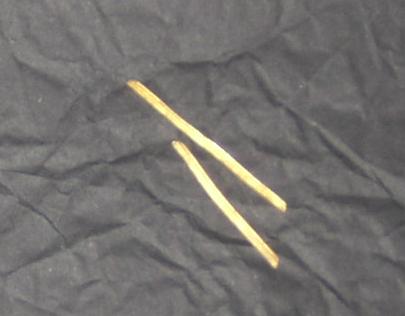
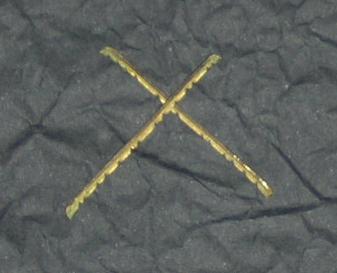
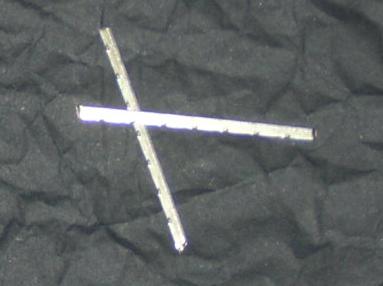
The first task in a refret is to decide what kind of fretwire you wish to use. If it is an old instrument and you want to keep it as authentic as possible, there are several options, A-C. It is not now normally possible to acquire these types of old fret, except where they have been recovered from an old instrument. Some are available on the restoration page.

If you are replacing with new frets, there are a bewildering range of fret sizes to choose from, available from both StewMac and Touchstone. In the end, it may come down to your personal preference. Some prefer chunkier frets, but these could be said to pull the strings out of tune more. Others prefer lighter frets, but with these it is often seen as harder to get a clean note. Your choice.

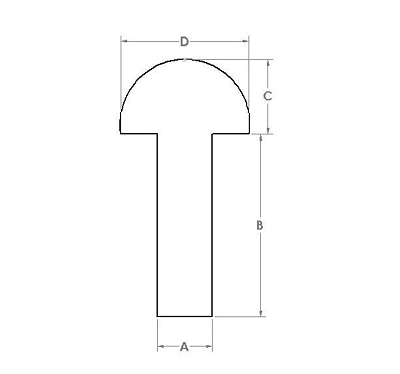
A. Bar frets (brass or 'German Silver') B. Early T frets C. T frets with tangs D. Modern T frets

   Another area of difficulty with old mandolins is worn frets, and with damaged instruments, missing frets. I always try to replace like with like to maintain the authenticity of old instruments, but this is not always possible.

   If frets are too worn, or missing ones can't be matched, they must be replaced. They can be replaced with period replacements, or a modern alternative. 

Here the old brass frets have been removed and the fingerboard given a light sanding to level the surface.

    A small smear of glue is added to the bottom of the fret, and I tend to bend them slightly, which further helps to keep them in place. Then new frets are tapped carefully into the cleaned slots, and checked continuously for level over the length of the fingerboard.

Ends are clipped once the glue has set, but I hold the fret down with a block of wood while I do this nevertheless.

Afterwards, it may still be necessary to level the frets... Small variations in height are difficult to avoid, especially where the top flexes as the top frets are tapped in. Check the level with a steel rule along the top.

 Finally the ends are dressed with a file to remove any rough or sharp edges.