| Re-setting a Mandolin Neck | ||||
| Home | Contact | Hospital | Neck Problems | German neck reset |
|
Italian bowls |
|||
|
After removal of the top, the neck and heel are removed using
heat and/or steam where necessary. It will make a reset much simpler
if the top section of the heel can be removed leaving the bottom section
in situ. Once removed it needs to be cleaned of old glue and bits of
the stringing that often come away with the heel.
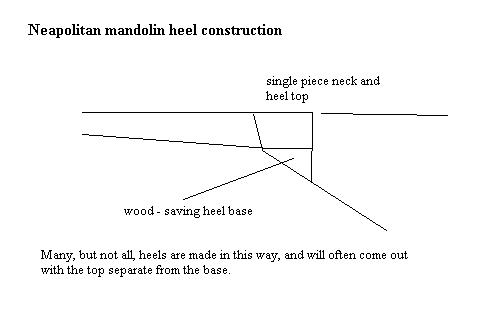
The two diagrams below explain the Italian heel construction, and shimming between the two heel sections to alter the neck angle. Plane a few thin shims to place between the two sections of the heel, allowing varying angles for best fit. |
|||
|
|
|
||
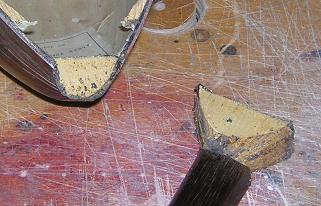
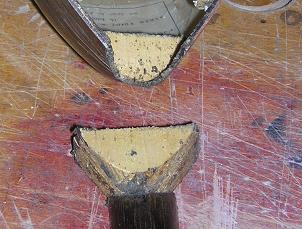
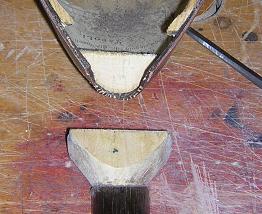
| Here the heel can be clearly seen to be in two sections, after removal and then cleaned. |
|
|
|
| The most difficult
element in a neck reset, is to calculate how much you need to tilt the
neck and head back. When viewed from the side, there are several planes/lines
on the mandolin. The most crucial is the line of the top, which, even
though it is not there, can be fairly accuratley gauged by the line of
the side clasps.
There are a couple of things to remember before proceeding:
Assuming you have the lower half of the heel still in place, proceed as follows:
In the final analysis, there is some latitude when you align the neck, as any inconsistencies can be sanded out later, or in the worst cases, even shimmed. The worst thing to do is push the neck back to far, better too little than too much.... always err on the side of caution!
|
|||
In order to glue
up after determining the correct wedge size and angle, you will need
some simple jigs. I have used others, but these have evolved as the
easiest to make and use.
|
|||
|
|
Side wedges to enable you to
apply press on the sides. Cut to fit the shape of the bowl, (they do
vary) and tape on.
I use one of these, with a wide groove chiselled in its long face to tape to the mandolin back, enabling down pressure to be applied to the heel. |
|
Neck clamp, also used to clamp
fretboards, provides a solid block against which the wedges can be
pushed so that they don't slip.
It also provides a flat surface against which to apply longitudinal pressure to the back of the heel. |
|
|
|
|
![]() |
|
Here I am using a straight length of edging wood to judge the new set up of the neck. For ease of use it is taped to the neck..... otherwise you need 4 hands!! |
The back wedge in place, to allow down clamping pressure. |
Another jig, this time used to reglue the lower portion of the heel back in place. Can also be used when resetting the heel. |
Here the heel was still in place, but the sides had been pushed out. I am regluing the heel sides, but it illustrates the set up for a complete heel reset. |
|
Gluing Up Before final gluing up, make sure everything is double checked for fit, and all cauls and wedges are selected and to hand. A quick check list is as follows....
|
|||
|
|
|
|
|
|
Here the heel is being reset with just a back wedge, but it is not as easy to get a good pressure without the neck clamp in place. |
Side view of the same set-up. The tape and elastic was to ensure the bowl stayed true. |
Here I am gluing in an end plate, to improve the structural integrity of the new heel set up, after the glue has set. | In this view, the small wedges that I often use to strengthen the lining-heel joints are visible. |